The ZP Series Rotary Tablet Press is designed for continuous compression of round, irregular and engraved tablets for pharmaceutical, nutraceutical, food and chemical industries. Available in multiple models, the series provides flexible production capacity for laboratories, pilot production and commercial manufacturing.
Built with a precision rotary turret, adjustable compression force and user-friendly controls, the machine delivers consistent tablet weight, hardness and thickness while ensuring stable operation during long production runs. The enclosed stainless steel structure complies with GMP requirements and allows easy cleaning and maintenance.
Whether producing pharmaceutical tablets, vitamin tablets, herbal products or food tablets, the ZP Series offers an efficient and cost-effective solution for continuous tablet manufacturing.

High Production Efficiency
Designed for continuous rotary compression, the ZP Series delivers stable tablet output while maintaining consistent weight and hardness.
GMP-Compliant Design
The enclosed stainless steel structure minimizes contamination and simplifies cleaning and maintenance.
Flexible Tablet Production
Suitable for producing round, irregular and engraved tablets for pharmaceutical, nutraceutical, food and chemical applications.
Easy Operation
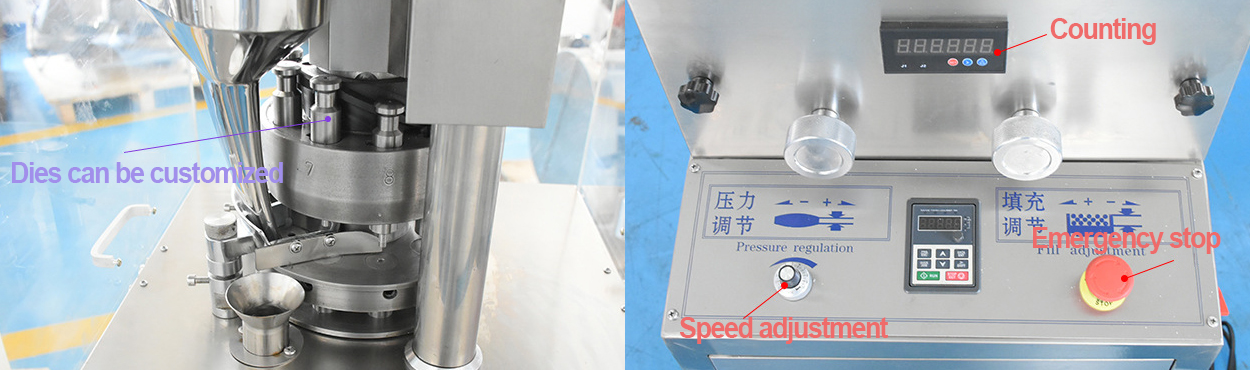
Equipped with intuitive controls and adjustable compression settings for convenient operation and quick product changeovers.
Multiple Models Available
The ZP Series is available in various models to meet different production capacity requirements, from small-scale to commercial manufacturing.
Reliable Performance
Precision mechanical transmission and durable components ensure stable operation during long production runs.
|
Industry |
Typical Products |
|
Pharmaceutical |
Tablets, OTC medicines |
|
Nutraceutical |
Vitamins, Minerals |
|
Food |
Candy Tablets, Milk Tablets |
|
Chemical |
Catalyst Tablets, Cleaning Tablets |

The ZP Series Rotary Tablet Press operates through a continuous rotary compression process. Granular material is fed into the die cavities where upper and lower punches apply compression to form tablets. Finished tablets are automatically discharged while the turret continues rotating, ensuring efficient and stable production.
|
Model |
Stations |
Max. Output |
Max. Tablet Ø |
Max. Thickness |
Recommended For |
|
ZP-5B |
5 |
9,000 tablets/h |
20 mm |
6 mm |
Laboratory & Small Batch |
|
ZP-7B |
7 |
12,600 tablets/h |
20 mm |
6 mm |
Small Production |
|
ZP-9B |
9 |
16,200 tablets/h |
20 mm |
6 mm |
Medium Production |
|
ZP-11B |
11 |
16,500 tablets/h |
16 mm |
6 mm |
Commercial Production |
|
ZP-12B |
12 |
18,000 tablets/h |
16 mm |
6 mm |
Continuous Production |
l One main machine with enclosed force feeder
l One set of round dies (customizable patterns and shapes available)
l One set of routine maintenance tools
Generally speaking, the following parameters need to be confirmed for model selection:
① Confirm whether your powder is suitable for tableting.
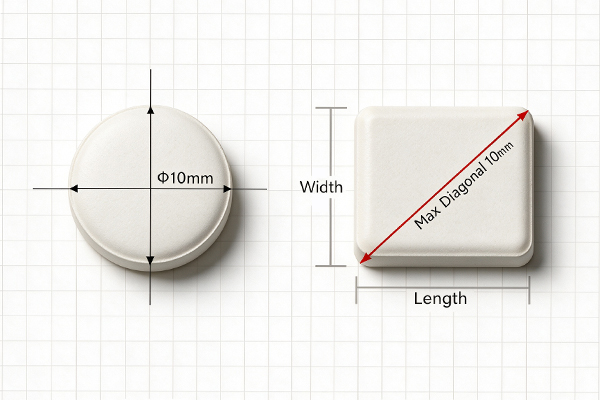
② Diameter of round tablets (the maximum diagonal length shall be provided for special-shaped tablets).
③ Required tablet thickness.
④ Required production capacity.

|
Equipment |
Function |
|
Uniform powder mixing |
|
|
Vacuum Feeder |
Automatic powder feeding |
|
Tablet Press |
Tablet compression |
|
Remove tablet dust |
|
|
Metal contamination detection |
|
|
Automatic tablet counting |
|
Material |
Suitable |
|
Pharmaceutical Granules |
✔ |
|
Vitamin Powder |
✔ |
|
Calcium Carbonate |
✔ |
|
Herbal Extract Powder |
✔ |
|
Effervescent Granules |
✔ |
|
Candy Powder |
✔ |
|
Veterinary Formulations |
✔ |
1. Dry Powder
Raw materials must be fully dry, with moisture content controlled below 5%.
2. Flowability
Materials shall have good flow performance. The ideal particle fineness for tableting ranges from 20 to 60 mesh, with a small proportion of fine powder mixed in for optimal results. If the material has poor flowability, granulation treatment is recommended. For detailed operations, please refer to our Granulation Guide.
3. Adhesiveness
Adhesiveness refers to the property that powder can agglomerate and bond together under external pressure. Materials lacking natural adhesiveness need binders to improve forming performance, such as maltodextrin, sugar, starch, microcrystalline cellulose, etc.
4. Low Oil Content
Excessive oil inside raw materials will severely hinder tableting forming. Therefore, the material cannot contain high levels of grease.
Q1: What materials can the ZP Series Rotary Tablet Press process?
A1: The ZP Series is suitable for compressing free-flowing powders and granules. It is widely used for pharmaceutical, nutraceutical, food and chemical tablet production.
Q2: What tablet shapes can the machine produce?
A2: The machine supports round, oval, irregular and engraved tablets. Custom punch tooling is available for different tablet designs.
Q3: How do I choose the right ZP model?
A3: Choose the model based on your required tablet size, production capacity and application. Contact our team for professional model recommendations.
Q4: Is the machine GMP compliant?
A4: Yes. The machine features stainless steel contact parts, an enclosed structure and an easy-to-clean design that meets GMP production requirements.
Q5: What tooling options are available?
A5: The ZP Series supports B and D tooling, depending on the model. Different tooling configurations are available for various tablet sizes and shapes.
Q6: What maintenance is required?
A6: Regular cleaning, lubrication and inspection of punches and dies help maintain stable performance and extend machine service life.
Q7: Can the ZP Series be integrated into a production line?
A7: Yes. It can be combined with mixers, vacuum feeders, tablet dedusters and counting machines to build a complete tablet production line.
Q8: Can the machine produce bilayer tablets?
A8: The ZP Series is designed for standard tablet production. For bilayer tablets, we recommend the ZPW Series Double Rotary Tablet Press.
l Tablet Compression Made Easy: Understanding Excipients
l Common Mechanical Issues in Tablet Press